Wednesday, August 31, 2011

20 Useful Free PSD files and Templates

Pricing+Table+%2528PSD%2529.jpg  Progress+Loading+Indicators+PSD.jpg

Are you searching new PSD stuff for you next project? After a long time here is a roundup of 20 beautiful as well as useful PSD files which you can download for free.

Each PSD pack is unique in its own way; you can click on the link and download the file from its original source. If you liked this post then feel free to comment and share with your friends.

Read more: MachoArts
QR: 20-useful-free-psd-files-and-templates

Posted via email from Jasper-Net

Android continues to grow, now makes up 42% of U.S. smartphone market

comScore_July_111.png

Earlier this morning, comScore released their quarterly report of the U.S. smartphone market for the three month period ending July 31. The report measures market share across three segments of the mobile market: manufacturers, platform (operating system), and service use.

Manufacturers

When it comes to cell phone manufacturers for both smartphones and non-smartphones, Samsung continued to hold the lead with 25.5%, up 1% from the period ending April 2011. LG and Motorola round out the top three, with 20.9% (+0.0%) and 14.1% (-1.5%) respectively. Apple found itself in the 4th spot with a 9.5% share (+1.2%), and struggling RIM dropped to 7.6% (-0.6%).

Sadly, comScore did not report the market share for only smartphone manufacturers, which is what we as Android users are really interested in. It is, however, nice to see manufacturers that make Android smartphones in the top 3 spots overall.

Read more: Android and Me
QR: https://chart.googleapis.com/chart?chs=80x80&cht=qr&choe=UTF-8&chl=http://androidandme.com/2011/08/news/android-continues-to-grow-now-makes-up-42-of-u-s-smartphone-market/

Posted via email from Jasper-Net

42 Outstanding FREE UI Kits for Web Designers

1.jpg 15.jpg

Introduction

Internet is full of freebies for web designers and developers. Today, we will be covering 42 free UI Kits and templates. All of them are editable in PSD format and mostly covering all of the basic UI elements such as textfield, checkboxes, radio buttons, buttons, drop down menu and some other cover extensive list of elements.

Well, you might say, "They're gorgeous! But what can I do with it?". The simplest way to use it - Prototyping. You can create wireframe/prototype to present your idea to your client. You also can use this UI kit to reskin HTML/Software/App form.

Mac and Windows platforms, they both render the form interface differently, and it's inconsistant in different browsers as well. So, I have found a few tools, tutorials that might able to give you a head start to make sure you know what to do with these beautiful and nicely done User Interface Kit.

However, you will need to do a little bit of investigation to integrate it. But once you've figure it out, you will have an amazing form in your website!

Read more: Queness
QR: 42-outstanding-free-ui-kits-for-web-designers

Posted via email from Jasper-Net

Google blacklists 247 certificates. Is it related to DigiNotar hacking incident?

After yesterday's news concerning the fake certificate found in Iran that allowed an attacker to impersonate Google.com, Vasco, the parent company of certificate authority DigiNotar, released a statement explaining what happened.

As is usually the case with security incidents, the statement was light on details, but claims the certificate authority was hacked and certificates for a "number of domains" were signed by the hackers using their root certificate.

Certificate authorities are "trusted" entities who validate the certificates that allow people to create encrypted connections to web servers.

They are responsible for confirming the identity of the entity requesting a certificate so that people are unable to impersonate other people's servers.

DigiNotar discovered they were hacked on July 19th, but the intrusion began at least as early as July 10th, 2011.

They performed an audit and revoked what they thought were all of the fraudulently issued certificates, but somehow missed one that was created to impersonate Google.

Read more: Naked security
QR: https://chart.googleapis.com/chart?chs=80x80&cht=qr&choe=UTF-8&chl=http://nakedsecurity.sophos.com/2011/08/31/google-blacklists-247-certificates-is-it-related-to-diginotar-hacking-incident/

Posted via email from Jasper-Net

Apache 2.2.20 released to fix DoS vulnerability

This afternoon the Apache Foundation released an awaited fix to the denial of service (DoS) vulnerability reported a few days ago.

The fixes in version 2.2.20 of the Apache httpd server reduce the amount of memory that is used by range requests. If the total bytes of a file requested exceed the total file size, httpd will return the entire file.

This follows closely on the heels of a tool released to the Full Disclosure mailing list this week that exploits the flaw.

Read more: Naked security
QR: https://chart.googleapis.com/chart?chs=80x80&cht=qr&choe=UTF-8&chl=http://nakedsecurity.sophos.com/2011/08/31/apache-2-2-20-released-to-fix-dos-vulnerability/

Posted via email from Jasper-Net

Bring Your Desktop to the Wild Side with the Safari Theme for Windows 7

sshot4e52fa2184187.png

Do you love animals? Then you will definitely want to download this beautiful theme featuring wildlife from across the world. The theme comes with 40 Hi-Res wallpapers, wild animal icons, and custom sounds to make your desktop come alive with wildlife.

Read more: How-to geek
QR: https://chart.googleapis.com/chart?chs=80x80&cht=qr&choe=UTF-8&chl=http://www.howtogeek.com/news/bring-your-desktop-to-the-wild-side-with-the-safari-theme-for-windows-7/6219/

Posted via email from Jasper-Net

Akamai Employee Tried To Sell Secrets To Israel

    A 43-year-old former Akamai employee has pleaded guilty to espionage charges after offering to hand over confidential information about the Web acceleration company to an agent posing as an Israeli consular official in Boston. Starting in September 2007, Elliot Doxer played an elaborate 18-month-long game of cloak-and-dagger with James Cromer, a man he thought was an Israeli intelligence officer. He handed over pages and pages of confidential data to Cromer, providing a list of Akamai's clients and contracts, information about the company's security practices, and even a list of 1,300 Akamai employees, including mobile numbers, departments and e-mail addresses. Doxer delivered the information to a dead drop box 62 times. His motivation: To help Israel and to get information on his son and estranged wife, who lived outside the U.S., prosecutors said in court filings. Doxer faces 15 years in prison on the charges.


Read more: Slashdot
QR: Akamai-Employee-Tried-To-Sell-Secrets-To-Israel

Posted via email from Jasper-Net

Stupid Geek Tricks: Hacking the Windows Experience Index

sshot4e5d343808b7f.jpg

If you’ve ever checked your Windows Experience Index, you might wonder whether you can increase these numbers without buying a new PC. Today we’re going to show you how to hack the WEI to show whatever numbers you want.
Why You Might Want To Do This

So you might be wondering why in the world would you want to do this, firstly the Windows Experience Index has an API that programs can use to enable functionality. This means that if your score is too low, some parts of a program may have dumbed down functionality or even be completely disabled. You could use this hack to trick your system into allowing you to use features. Additionally if you are really geeky, like we are, you can use it to cheat in a benchmark test against your friends.
Hacking The XML File

The first method, and the most fun, requires some knowledge of XML files, however if you follow this tutorial you will be fine. So lets get started.

You are going to have to navigate to C:\Windows\Performance\WinSAT\DataStore

Read more: How-to geek
QR: https://chart.googleapis.com/chart?chs=80x80&cht=qr&choe=UTF-8&chl=http://www.howtogeek.com/71500/stupid-geek-tricks-hacking-the-windows-experience-index/

Posted via email from Jasper-Net

How can I get information about the items in the Recycle Bin?

For some reason, a lot of people are interested in programmatic access to the contents of the Recycle Bin. They never explain why they care, so it's possible that they are looking at their problem the wrong way.

For example, one reason for asking, "How do I purge an item from the Recycle Bin given a path?" is that some operation in their program results in the files going into the Recycle Bin and they want them to be deleted entirely. The correct solution is to clear the FOF_ALLOW­UNDO flag when deleting the items in the first place. Moving to the Recycle Bin and then purging is the wrong solution because your search-and-destroy mission may purge more items than just the ones your program put there.

The Recycle Bin is somewhat strange in that it can have multiple items with the same name. Create a text file called TEST.TXT on your desktop, then delete it into the Recycle Bin. Create another text file called TEST.TXT on your desktop, then delete it into the Recycle Bin. Now open your Recycle Bin. Hey look, you have two TEST.TXT files with the same path!

Now look at that original problem: Suppose the program, as part of some operation, moves the file TEST.TXT from the desktop to the Recycle Bin, and then the second half of the program goes into the Recycle Bin, finds TEST.TXT and purges it. Well, there are actually three copies of TEST.TXT in the Recycle Bin, and only one of them is the one you wanted to purge.

Okay, I got kind of sidetracked there. Back to the issue of getting information about the items in the Recycle Bin.

The Recycle Bin is a shell folder, and the way to enumerate the contents of a shell folder is to bind to it and enumerate its contents. The low-level interface to the shell namespace is via IShell­Folder. There is an easier-to-use medium-level interface based on IShell­Item, and there's a high-level interface based on Folder designed for scripting.

I'll start with the low-level interface. As usual, the program starts with a bunch of header files.

#include <windows.h>
#include <stdio.h>
#include <tchar.h>
#include <shlobj.h>
#include <shlwapi.h>
#include <propkey.h>

The Bind­To­Csidl function binds to a folder specified by a CSIDL. The modern way to do this is via KNOWN­FOLDER, but just to keep you old fogeys happy, I'm doing things the classic way since you refuse to upgrade from Windows XP. (We'll look at the modern way later.)


Read more: The Old New Thing
QR: 10202076.aspx

Posted via email from Jasper-Net

Best Procrastination Tip Ever

Your first thought as you look at this article will be, “I’ll read this later.”

But don’t. Let the urge to switch to a new task pass. Read this now.

It’ll take you two minutes. It’ll save you countless hours.

I’ve written the book on ending procrastination, but I’ve since come up with a very simple technique for beating everyone’s favorite nemesis. It is incredibly easy, but as with anything, it takes a little practice.

Try it now:

Identify the most important thing you have to do today.

Decide to do just the first little part of it — just the first minute, or even 30 seconds of it. Getting started is the only thing in the world that matters.

Clear away distractions. Turn everything off. Close all programs. There should just be you, and your task.

Sit there, and focus on getting started. Not doing the whole task, just starting.

Pay attention to your mind, as it starts to have urges to switch to another task. You will have urges to check email or Facebook or Twitter or your favorite website. You will want to play a game or make a call or do another task. Notice these urges.

Read more: zenhabits
QR: https://chart.googleapis.com/chart?chs=80x80&cht=qr&choe=UTF-8&chl=http://zenhabits.net/tada/

Posted via email from Jasper-Net

WinDbg / i386kd Primer

A handful of people on my team are working with the Windows code base to ensure we don't break them with compiler changes, and since some of them were new to kernel debugging, I put together a rather quick introduction to windbg/i386kd. The slide deck can be found here.

Read more: Software Sleuthing
Read more: Example
QR: view?id=0AZOAQ1DIXFd4ZGdqZ2R4OWhfMTFmZDhoY2JnZg&hl=en

Posted via email from Jasper-Net

Twitter OAuth authentication using .Net

dev-bird.gif

Introduction

In this article I want to demonstrate how to implement OAuth authentication in .Net. I've previously written about my dislike of third party SDKs for social media integration and how we should leverage technology based solutions instead. One of the sticking points in doing this tends to be that implementing OAuth based authentication is relatively difficult compared with actually making the requests themselves. There is documentation available, but there seems to be a lack of .NET example code to go with it.

In keeping with my thoughts in previous articles I would recommend using open source OAuth based libraries to solve this problem, and again avoid resorting to third party Twitter/Facebook implementations which more strongly couple code to specific APIs. This keeps the solution more reusable and builds on specific technologies to better future proof your application.

I've also previously shown how client-side plugins can be used in combination with server-side code to speed development in this area. However sometimes authentication does need to be implemented purely on the server-side.

So how difficult is this?

It turns out implementing OAuth on the server-side in .Net isn't too difficult, the battle is getting the encoding and authentication signature right. With so few examples it can be a little daunting, so here's an example written in pure .NET using the official Twitter OAuth documentation and a bit of trial and error.


Background

The following example shows how to authenticate against the Twitter APIs using a registered Twitter application. Any interaction with the APIs when authenticated in this manner will behave as if coming from the Twitter account under which the application has been registered. It's therefore useful for sending out status updates or sending out notifications from a specific account.

Usually OAuth requires redirecting the user to a login screen to obtain an oAuth token which requires a bit more work. However when authenticating via a Twitter application this step is skipped as your application already has an oAuth token provided (access token). Whether you are using the application oAuth token or a user oAuth token, the following code can be used to authenticate against the twitter APIs.


The Code

The first step is to visit the Twitter developer section and register a new application. On completion you will be provided with a set of public/private keys which you will need the replace in the example below in order to run. The values I have used directly correspond with the documented example here. Make sure you replace them with your own.

var oauth_token           = "819797-Jxq8aYUDRmykzVKrgoLhXSq67TEa5ruc4GJC2rWimw";
var oauth_token_secret    = "J6zix3FfA9LofH0awS24M3HcBYXO5nI1iYe8EfBA";
var oauth_consumer_key    = "GDdmIQH6jhtmLUypg82g";
var oauth_consumer_secret = "MCD8BKwGdgPHvAuvgvz4EQpqDAtx89grbuNMRd7Eh98";


Read more: Codeproject
QR: TwitterOAuth.aspx

Posted via email from Jasper-Net

Illusions theme by Josh Sommers free download available for Windows 7

7268.illusions_5F00_12B9C557.png

“Optical illusions, planets of grass floating in impossible summer skies, and homages to M.C. Escher fill this free Windows 7 theme of weird and wonderful digital art by Josh Sommers.”


Read more: I'm PC
Read more: Theme
QR: illusions-theme

Posted via email from Jasper-Net
.net OpenOffice Automation Library

libreoffice-3.3RC.png

Project Description
The .net OpenOffice Automation Library makes it easier for .net developers to control OpenOffice or LibreOffice through the automation interface. You'll no longer have to browse the Uno docs and call everything by refelction. It's developed in C#.

Creators comment
OOLib is far away from being complete. This project is mainly created for my needs.
This started as a very simple Delphi project which put all functionallity inte a hand full classes.
This project is a collection of wrapper classes for the OpenOffice UNO Services and interfaces.
Additionally some classes will be extended by some usefull utility functions.

What is missing

    The majority of classes (services) is not implemented.
    The implemented classes does not support all of the interfaces.
    So far I could not get the listeners working. I would like to map the listener events to classic .NET events. Any help here is appreciated.
    Testing in general
    Test/sample programs


What is done already

    Implementing some basic classes
    Implementing a lot of classes related to TextDocument


Read more: Codeplex
QR: https://chart.googleapis.com/chart?chs=80x80&cht=qr&choe=UTF-8&chl=http://oolib.codeplex.com/

Posted via email from Jasper-Net

Visual Studio 2010 Service Pack 1 Update, KB2529927, released fixing VS2008 -> VS2010SP1 Setup Project Migration GUID issue...

Migrating setup project from VS2008 to VS2010SP1 changes component GUIDs, which causes upgrades to fail

Version: 10.0
Date Published: 8/30/2011

Change Language: Chinese (Simplified) Chinese (Traditional) English French German Italian Japanese Korean Russian Spanish

KB Articles: KB2529927

VS10SP1-KB2529927-v2-x86.exe 2.0 MB

Overview

When you install the .msi file that is created from the Visual Studio 2010 SP1 Setup project, the .msi file determines that the GUID has changed. Therefore, the .msi file removes the files and registry keys for the installation path by using the sequence of the project. This issue occurs because a different hashing algorithm is used to create the Globally Unique Identifiers (GUIDs) in Visual Studio 2010 SP1.

To resolve this issue, apply this hotfix, and then set the new BackwardCompatibleIDGeneration property to True before you build the project.

This hotfix introduces the BackwardCompatibleIDGeneration property. By default, this property is set to False. Before you build the Setup project in Visual Studio 2010 SP1, you have to explicitly set the BackwardCompatibleIDGeneration property to True


Read more: Greg's Cool [Insert Clever Name] of the Day
Read more: Update for Microsoft Visual Studio 2010 Service Pack 1 (KB2529927)
QR: details.aspx?id=27211

Posted via email from Jasper-Net

Tuesday, August 30, 2011

When to use T-SQL or SSIS for ETL

When doing ETL, you have the choice of using T-SQL or SSIS.  What things should you consider when deciding which one to use?  Here are some of the major design considerations to think about:

    Performance - With T-SQL, everything is processed within the SQL engine.  With SSIS, you are bringing all the data over to the SSIS memory space and doing the manipulation there.  So if speed is an issue, usually T-SQL is the way to go, especially when dealing with a lot of records.  Something like a JOIN statement in T-SQL will go much faster than using lookup tasks in SSIS.  Another example is a MERGE statement in T-SQL has much better performance than a SCD task in SSIS for large tasks
    Features/capabilities – Some features can only be done in either T-SQL or SSIS.  You can shred text in SSIS, but can’t in T-SQL.  For example, text files with an inconsistent number of fields per row can only be done in SSIS.  So certain tasks may force you into using one or the other
    Current skill set – Are the people in your IT department more familiar with SSIS or T-SQL?
    Ease of development/maintenance – Of course, whatever one you are most familiar with will be the easiest, but if your skills at both are fairly even, then SSIS is usually easier to use because it is graphical, but sometimes you can develop quicker in T-SQL.  For example, having to join a bunch of tables will require a bunch of tasks in SSIS, where in T-SQL it is one statement.  So it might be easier to create the tasks to join the tables in SSIS, but it will take longer to build then writing a T-SQL statement
    Complexity – SSIS can be more complex because you might need to create many tasks to accomplish your objective, where in T-SQL it might just be one statement, like in the example above for joining tables
    Extensibility – SSIS has better extensibility because you can create a script task that uses C# that can do just about anything, especially for non-database related tasks.  T-SQL is limited because it is only for database tasks.  SSIS also has logging, which T-SQL does not
    Likelihood of depracation/breaking changes – Minor issue, but T-SQL is always removing features in each release that will have to be rewritten
    Types/architecture of sources and destinations – SSIS is better if you have multiple types of sources.  For example, it works really well with Oracle, XML, flat-files, etc.  SSIS was designed from the beginning to work well with other sources, where T-SQL is designed for SQL Server and it requires more steps to access other sources, and there are additional limitations when doing so
    Local regulations – Are there some company standards you have to adhere to that would limit which tool you can use?

If you decide T-SQL is the way to go and you just want to execute a bunch of T-SQL statements, it’s still a good idea to wrap them in SSIS Execute SQL Tasks because you can use logging, auditing and error handling that SSIS provides that T-SQL does not.

Read more: James Serra's Blog
QR: when-to-use-t_2D00_sql-or-ssis-for-etl.aspx

Posted via email from Jasper-Net

Update the WPF UI now: how to wait for the rendering to finish ?

WPF is really awesome to build reactive applications and data binding is here to push useful information inside of the User Interface. All is done magically and it’s wonderfully simple to create an application without knowledge of the internals of the WPF’s rendering.

Now, I wan’t to talk about something which can useful in every WPF application : how to wait for the rendering UI to be done. This can also be rephrased to : “how to force the rendering after I performed an action ?“.

Why would I need this ?

You can find a lot of reasons to need this:

    You are doing a long-running job that can only be done on the UI thread (good bye BackgroundWorker) and you want to tell the user the progress of the task.
    The rendering of a control takes a lot of time to be done and you want to be sure that the “wait please” Textblock” is rendered instead of a white screen.
    You need to wait that the UI rendering following an action is done.
    You are a geek and you want to know how you can do this !
    You are adding a lot of items to a binded collection and you want to wait for the rendering of each added item to be done. By doing this, the data won’t seems to be push into the ItemsControl by packet but one by one. No apparent freeze of the UI. As pointed out by a lot of people, there is really better ways to do this.

Here is a non-exhaustive list of things that can only be done on the UI-Thread and which are time-consuming (if you have some others, please give me them in the comments):

    Create UI controls may be long(exemple),
    Im my previous project using Mogre 3D, I needed to initialize some parts of the 3D engine in the main UI Thread,
    Sometimes applying the content to a view is very long because the XAML is really complex (more to come on this in a later post),
    etc.


Please tell me how can I do this !

What is wonderful is that the solution takes only one little line of code. One line of code.

To keep it simple, the rendering of the UI is perform on the UI thread via the Dispatcher. It can be considered as a tasks processer, each of these task being assigned a priority. The rendering of the UI is one of these tasks and all you have to do is tell the Dispatcher: “perform an action now with a priority less than the rendering”. The current work will then wait for the rendering to be done.

Here is the snippet this sentence transposing in .Net:

Dispatcher.Invoke(new Action(() => { }), DispatcherPriority.ContextIdle, null);

Read more: Yet another blog about
QR: https://chart.googleapis.com/chart?chs=80x80&cht=qr&choe=UTF-8&chl=http://www.jonathanantoine.com/2011/08/29/update-my-ui-now-how-to-wait-for-the-rendering-to-finish/

Posted via email from Jasper-Net

Working with AssemblyCatalog in MEF

MEF is a component defined in Base class library for extensibility. If you are really looking for writing something that extend itself at runtime, or that supports plugins to be attached to it, you should give MEF a try. You can read how MEF works from my post here. In this post I will demonstrate how to use AssemblyCatalog in MEF World.

A Catalog is a container that lists Parts where each Part is actually mapped to a Type which individually hosts a number of Exports in forms of ExportDefination and number of Import in forms of ImportDefinations. An AssemblyCatalog is actually a collection of TypeCatalogs where the Types are actually defined within one particular assembly.

Lets take a look at AssemblyCatalog using our previous code :

public class ExportContainer
{
[Export]
public string ExportName { get; set; }

[Export]
public string GetName()
{
return this.ExportName;
}

[Export]
public Action MyActionDelegate { get; set; }

}

Now if I use Assemblycatalog to load the Catalog into Parts we write :

static void Main(string[] args)
{
   AssemblyCatalog catalog = new AssemblyCatalog(Assembly.GetExecutingAssembly());

   Console.WriteLine(catalog.Parts.Count());

   Console.ReadKey(true);
}


Read more: Daily .Net Tips
QR: https://chart.googleapis.com/chart?chs=80x80&cht=qr&choe=UTF-8&chl=http://dailydotnettips.com/2011/08/30/working-with-assemblycatalog-in-mef/

Posted via email from Jasper-Net

Accessing data in ISO and VHD files

The trend of incredibly large and small form-factor hard disks means we can store ever increasing amounts of data without worrying about running out of capacity. Windows 8 enables easy access to the contents of two important storage formats, ISO and VHD files. While we generally think of these formats when they appear on media, they are also very useful as files within a file system and that is where native support in Explorer comes in handy.
Working with ISO files

While optical discs continue to be useful in many situations, large hard disks allow us to decrease our dependence on them. Personally, I’ve spent a load of my time (legally) ripping about 900 GB worth of music, and more recently almost 1TB of home video DVDs into my collection. I know that my backup of our photos and home movies is probably the most important data in my house. Together with backups, storing the most basic things in my house now requires terabytes of space. Just a couple of years ago that was an unimaginable amount of storage. These days, however, I know I can buy a 3TB hard disk for less than $200.

Given cheap hard disks and our mobile lifestyle, we have little interest in carting around collections of discs. Also, we expect to be able to receive content as well as share and collaborate with friends, family, and colleagues in an instant – typically through online file transfers. Last but not least, our desire for thin and light form factors such as slates and ultra-mobile laptops often leaves no room for vendors to add optical disc drives. This is exactly the feedback we received from many of you who used Windows 7 – the ability to directly use ISO files (also known as ISO images) without requiring a physical CDROM or DVD drive is very important.

A quick refresher on ISO files might be helpful. ISO refers to the International Organization for Standardization which is an international standard-setting body, and a world leader in developing and publishing international standards. For the purpose of this blog entry, our interests lie in a couple of standards published by ISO, namely ISO-9660 and ISO-13346. Simply stated, these two standards each describe a method by which photos, video, applications, documents or other content (excluding CD audio) are organized on CDROM or DVD optical media. The reason for the popularity of these standards is they allow CDROM and DVD media content to be easily interchanged across systems from different vendors e.g. you can create a DVD on a Windows PC and read it in your living room DVD player. An ISO file is simply a disc image stored as a file, composed of all of the contents of a CDROM or DVD disc. You can also think of an ISO file as a full-fidelity image (digital copy) of the optical disc.

Read more: Building Windows 8
QR: accessing-data-in-iso-and-vhd-files.aspx

Posted via email from Jasper-Net

Falsely issued Google SSL certificate in the wild for more than 5 weeks

googlecert325.jpg?w=325&h=390

Update: Mozilla have announced out of an abundance of caution that they are releasing new versions of Firefox, Firefox Mobile and Thunderbird to revoke the trust of DigiNotar's root certificate for signing certificates.

I presume this is because DigiNotar has not explained how the Google certificate was signed and to prevent further abuse. This could cause issues for websites who have purchased certificates from DigiNotar.

It remains to be seen whether other browsers will follow in Mozilla's foot steps, but it may be prudent to remove DigiNotar from your trusted certificates until there is further clarification.

Update 2: Google is following Mozilla's lead by marking DigiNotar untrusted in the next release of the Chrome OS (Chromium).

Original post: Reports surfaced this morning that accuse the government of Iran with trying to perform a man-in-the-middle attack against Google's SSL services.

Padlock keyA user named alibo on the Gmail forums posted a thread about receiving a certificate warning about a revoked SSL certificate for SSL-based Google services.

The certificate in question was issued on July 10th by Dutch SSL certificate authority DigiNotar. DigiNotar revoked the certificate today at 16:59:03 GMT, but many browsers do not check for revoked certificates by default.

Rogue Google certificateThe certificate was valid for *.google.com and raises serious questions about who the certificate was issued to, and how it was signed.

Read more: Naked security
QR: https://chart.googleapis.com/chart?chs=80x80&cht=qr&choe=UTF-8&chl=http://nakedsecurity.sophos.com/2011/08/29/falsely-issued-google-ssl-certificate-in-the-wild-for-more-than-5-weeks/

Posted via email from Jasper-Net

Windows 8: Improvements in Windows Explorer

Windows 8 is about reimagining Windows, so we took on the challenge to improve the most widely used desktop tool (except maybe for Solitaire) in Windows. Alex Simons on the program management team authored this post with a detailed look at the evolution of Explorer and the major improvements to its interface and functionality for Windows 8. Judging by the passion on file operations and user interface design, we know this is an important subject so we expect a pretty engaged dialog on the topic. We put this in one lengthy post, will watch the comments and dialog, and down the road we'll continue the discussion.
-- Steven

It’s exciting to have this opportunity to share the improvements we’re making to the file management capabilities of Windows Explorer. Explorer is one of the most venerable parts of Windows with a heritage you can trace back to the “MS-DOS Executive” in Windows 1.0!

The new ribbon

The Home tab is focused on the core file management tasks, and we’ve put all the major file management commands there in prominent locations: Copy, Paste, Delete, Rename, Cut, and Properties. We’ve also given new prominence to two popular heritage features, Move to and Copy to, along with exposing a hidden gem, Copy path, which is really useful when you need to paste a file path into a file dialog, or when you want to email someone a link to a file on a server.

4300.Figure-9-_2D00_-Home-tab-crop_5F00_thumb.png

The Home tab is the heart of our new, much more streamlined Explorer experience. The commands that make up 84% of what customers do in Explorer are now all available on this one tab:

5775.Figure-10-_2D00_-Home-tab-usage-heatmap_5F00_thumb.png

Read more: Bink.nu
QR: windows-8-improvements-in-windows-explorer.aspx

Posted via email from Jasper-Net

Pirate Bay ืžืฆื™ื’ื”: ืฉื™ืชื•ืฃ ืงื‘ืฆื™ื ื—ื•ืงื™

bayfiles-logo.png

ืžื™ื™ืกื“ื™ ืืชืจ ื”ื‘ื™ื˜ื•ืจื ื˜ ื”ืคื•ืคื•ืœืืจื™ Pirate Bay ื”ืฉื™ืงื• ืืชืžื•ืœ (ื‘') ืคืœื˜ืคื•ืจืžื” ืœืฉื™ืชื•ืฃ ืงื‘ืฆื™ื ื‘ืฉื Bayfiles. ืœืื—ืจ ืฉืขื–ื‘ื• ืืช ืชื—ื•ื ื”ื˜ื•ืจื ื˜ื™ื, ืฉื ื™ื™ื ืžื”ืžื™ื™ืกื“ื™ื ื”ืžืงื•ืจื™ื™ื ืฉืœ ื”ืืชืจ ื—ื•ื–ืจื™ื ืขื ืžืขืจื›ืช ืฉื™ืชื•ืฃ ืฉืžื˜ืจืชื” ืœื›ื‘ื“ ื•ืœืฉืžื•ืจ ืขืœ ื–ื›ื•ื™ื•ืช ื”ื™ื•ืฆืจื™ื ืฉืœ ื‘ืขืœื™ ื”ืชื›ื ื™ื.
ืฉื™ืชื•ืฃ ื—ื•ืงื™

ืืชืจ Bayfiles ืขื•ื‘ื“ ื‘ื“ื•ืžื” ืœืืชืจื™ ืฉื™ืชื•ืฃ ืชื›ื ื™ื ื™ื“ื•ืขื™ื ื›ื’ื•ืŸ RapidShare ื•-MegaUpload. ืขืœ ื™ื“ื™ ื”ืงืœืงื” ืื—ืช, ื”ืžืฉืชืžืฉื™ื ื™ื›ื•ืœื™ื ืœื”ืขืœื•ืช ืงื‘ืฆื™ื ืืœ ืฉืจืชื™ ื”ืืชืจ ื•ืœืื—ืจ ืžื›ืŸ ืœืฉืชืฃ ืื•ืชื ืขื ื—ื‘ืจื™ื”ื. ืื—ืช ื”ืกื™ื‘ื•ืช ื”ืขื™ืงืจื™ื•ืช ืœื”ืฉืงืช ื”ืืชืจ ื”ื—ื“ืฉ, ื”ื™ื ืœืกืคืง ืœืžืฉืชืžืฉื™ื ืื•ืคืฆื™ื” ืืžื™ื ื” ื™ื•ืชืจ ืœืฉื™ืชื•ืฃ ื•ืื—ืกื•ืŸ ืงื‘ืฆื™ื.

ื‘ืืชืจ ืขืฆืžื• ืื™ืŸ ืชื™ื‘ืช ื—ื™ืคื•ืฉ ืื• ืกืคืจื™ื™ืช ืงื‘ืฆื™ื, ื›ืš ืฉืœื ื ื™ืชืŸ ืœืžืฆื•ื ืชื›ื ื™ื ืฉืžืฉืชืžืฉื™ื ืื—ืจื™ื ื”ืขืœื•. ื‘ื ื•ืกืฃ, ืชื ืื™ ื”ืฉื™ืžื•ืฉ ื”ืžื•ืคื™ืขื™ื ื‘-Bayfiles ืžื‘ื”ื™ืจื™ื ื›ื™ ืชื•ื›ืŸ ื”ืžืคืจ ื–ื›ื•ื™ื•ืช ื™ื•ืฆืจื™ื ืฉืœ ืฆื“ ืฉืœื™ืฉื™ ืื™ื ื• ืžื•ืชืจ ืœื”ืขืœืื” ื•ืžืฉืชืžืฉื™ื ืฉื™ื ืกื• ืœื”ืขืœื•ืช ืชื›ื ื™ื ืžืกื•ื’ ื–ื” ืžืกืคืจ ืคืขืžื™ื, ื™ื—ืกืžื• ืžื”ืืชืจ ื•ื—ืฉื‘ื•ื ื ื™ืžื—ืง.

ื‘ืจืื™ื•ืŸ ืฉืขืจืš ืืชืจ TorrentFreak, ืขื ืžื™ื™ืกื“ Bayfiles ืคืจื“ืจื™ืง ื ื™ื™ (Fredrik Neij) ื˜ืขืŸ ื ื™ื™ ื›ื™ ืฉื™ืจื•ืชื™ ื‘ื™ื˜ื•ืจื ื˜ ื”ื•ืœื›ื™ื ื•"ื ื—ื ืงื™ื" ื•ืืคื™ืœื• ืžืกื•ื ื ื™ื ื™ืฉื™ืจื•ืช ืขืœ ื™ื“ื™ ืกืคืงื™ื•ืช ื”ืื™ื ื˜ืจื ื˜, ื‘ืขื•ื“ ืฉ-HTTP ืœื. ืื•ืคืŸ ื”ืื—ืกื•ืŸ ื•ื”ืขื‘ืจืช ืงื‘ืฆื™ื ื‘-Bayfiles ืฉื•ืžืจ ืขืœ ืคืจื˜ื™ื•ืช ื”ืžืฉืชืžืฉื™ื ื•ืžื‘ื˜ื™ื— ืœื”ื ื›ื™ ื”ืžื™ื“ืข ืฉืœื”ื ื™ืฉืืจ ืชืžื™ื“ ื‘ืื•ื•ื™ืจ, ื›ืš ืฉื‘ืžื™ื“ื” ื•ื™ืจืฆื• ืœืฉื—ื–ืจ ื’ื™ื‘ื•ื™ – ื”ืงื•ื‘ืฅ ืชืžื™ื“ ื™ื”ื™ื” ื–ืžื™ืŸ. ืžืขื‘ืจ ืœื›ืš, ืคืจื“ืจื™ืง ืžื•ืกื™ืฃ ื›ื™ ื‘ืžื™ื“ื” ื•ืžืฉืชืžืฉื™ื ื‘ื•ื—ืจื™ื ืœืื—ืกืŸ ืืช ืงื‘ืฆื™ ื”-MP3 ืฉืœื”ื ื‘ืฉื™ืจื•ืช, ื”ื ื™ื•ื›ืœื• ืœื’ืฉืช ืืœื™ื”ื ื•ืืคื™ืœื• ืœืฉืžื•ืข ืื•ืชื ื‘ืกื˜ืจื™ืžื ื’, ื“ืจืš ื›ืœ ืžื›ืฉื™ืจ ืฉื”ื•ื.

ื›ืขืช Bayfiles ื”ื•ื ืืชืจ ืœืื—ืกื•ืŸ ื•ืฉื™ืชื•ืฃ ืงื‘ืฆื™ื, ืืš ื”ืžืงื™ืžื™ื ืžืชื›ื ื ื™ื ืœื”ืžืฉื™ืš ื•ืœืคืชื— ืื•ืชื• ืœืฉื™ืจื•ืช ืื—ืกื•ืŸ ืขื ืŸ, ืฉื™ืชืคืงื“ ื‘ืื•ืคืŸ ื“ื•ืžื” ืœ-Dropbox. ื›ืžื• ื‘ืืชืจ Pirate Bay, ื”ืžื˜ืจื” ื”ืกื•ืคื™ืช ื”ื™ื ืœื”ืคื•ืš ืืช ืื•ืคืŸ ืฉื™ืชื•ืฃ ื”ืงื‘ืฆื™ื ืœื™ืขื™ืœ ื™ื•ืชืจ.
ื ืชื•ื ื™ื ื˜ื›ื ื™ื™ื

Bayfiles ืžืฆื™ืข ืขื‘ื•ืจ ืžืฉืชืžืฉื™ื ืฉืื™ื ื ืจืฉื•ืžื™ื, ืืคืฉืจื•ืช ืœืฉืชืฃ ืงื‘ืฆื™ื ื‘ื ืคื— ืฉืœ ืขื“ 250 ืžื’ื”. ืžืฉืชืžืฉื™ื ืจืฉื•ืžื™ื ื™ื›ื•ืœื™ื ืœื”ืขืœื•ืช ืงื‘ืฆื™ื ื‘ื ืคื— ืฉืœ ืขื“ 500 ืžื’ื”, ื‘ืขื•ื“ ืฉืžืฉืชืžืฉื™ ืคืจื™ืžื™ื•ื ื™ื›ื•ืœื™ื ืœื”ืขืœื•ืช ืงื‘ืฆื™ื ื‘ื ืคื— ืฉืœ ืขื“ 5 ื’'ื™ื’ื”, ืœืœื ื”ื’ื‘ืœื” ื‘ืžืกืคืจ ื”ืงื‘ืฆื™ื ืฉื ื™ืชืŸ ืœื”ืขืœื•ืช.

Read more: newsGeek
QR: https://chart.googleapis.com/chart?chs=80x80&cht=qr&choe=UTF-8&chl=http://www.newsgeek.co.il/bayfiles-upload-service/

Posted via email from Jasper-Net

Integra System Monitor Compares System State, Files & Registry Changes

scan-1.png

Want to find out differences between current and previous system state without having to use folder watch applications that scan only for changes in files and folders? Integra System Monitor is a powerful application which deploys an efficient system state comparing mechanism in order to find out major system changes, updates and new additions to your PC. The application workability is based on simple principle; it allows you to create a snapshot of defined drives and registry hives. Once created, you can compare it with current system state to check what has been changed since last scan. It generates easy-to-understand report in shareable HTML format to view both file and folder changes and new additions to defined registry hives.
Integra System Monitor has been designed to give in-depth report of changes made to your system over time. Unlike similar tools, it can observe all registry hives and folder and file deletion, addition, and removal to show changes in evaluation reports.

After launching the application, it’s recommended to specify drives and registry hives which you wish to scan for changes. On the main interface, select Settings from Options menu. Here, specify drives and registry hives which are to be scanned.

Read more: Addictive tips
QR: https://chart.googleapis.com/chart?chs=80x80&cht=qr&choe=UTF-8&chl=http://www.addictivetips.com/windows-tips/monitor-and-compare-windows-system-state-files-registry-changes/

Posted via email from Jasper-Net

CloudStack Goes Open Source

CloudStack has dropped the open core model and gone completely open source. The latest merge of formerly-proprietary features include VMware and OracleVM support as well as support for dynamically managing hardware network and storage devices. CloudStack is the same software used by Edmunds.com, Zynga, Godaddy, and 60 other of the largest clouds.

Read more: Slashdot
QR: CloudStack-Goes-Open-Source

Posted via email from Jasper-Net

ืœื”ืขืฉื™ืจ ืืช ื—ื•ื•ื™ื™ืช ื”ืžืฉืชืžืฉ ืขื Woolik [ืกื˜ืืจื˜ืืค]

woolik-screenshot.png

ืกื˜ืืจื˜ืืค ื™ืฉืจืืœื™ ื—ื“ืฉ ื™ืืคืฉืจ ืœื›ื ืœืฉืคืจ ืืช ื—ื•ื•ื™ื™ืช ื”ืžืฉืชืžืฉ, ื•ืžืฆื™ืข ืžืกืคืจ ื›ืœื™ื ืขื‘ื•ืจ ื”ืฉืœืžืช ืžื˜ืจื” ื–ื•. ืชื›ื™ืจื• ืืช ื•ื•ืœื™ืง (Woolik), ื”ืกื˜ืืจื˜ืืค ืฉื™ืขื–ื•ืจ ืœื›ื ืœืขืฉื•ืช ื™ื•ืชืจ ืขื ื”ืžื—ืฉื‘ ืฉืœื›ื, ื•ืื ืืชื ืžืกื•ื’ ื”ืื ืฉื™ื ืฉื’ื ืขื•ื–ืจื™ื ืœืื—ืจื™ื ื‘ื‘ืขื™ื•ืช ืžื—ืฉื‘ื™ื, ื”ื•ื ื™ืขื–ื•ืจ ืœื›ื ืขื ื›ืœ ืื•ืชื ืงืจื•ื‘ื™ื ื•ื—ื‘ืจื™ื ืฉืขื‘ื•ืจื ืืชื ื˜ื›ื ืื™ ื”ืžื—ืฉื‘ื™ื ื”ืชื•ืจืŸ.

ื•ื•ืœื™ืง ืžืฆื™ืขื” ืžืกืคืจ ื›ืœื™ื ืฉื™ื›ื•ืœื™ื ืœืขื–ื•ืจ ืœื’ื•ืœืฉื™ื ืœื“ืขืช ื™ื•ืชืจ ืขืœ ืœื™ื ืงื™ื, ืขื•ื“ ืœืคื ื™ ืฉื”ื ืœื•ื—ืฆื™ื ืขืœื™ื”ื. ื›ืš ืœืžืฉืœ ืžืฆื™ืขื” ื”ื—ื‘ืจื” ื›ืœื™ ืฉืžืฉื“ืจื’ ืืช ืžื ื•ืขื™ ื”ื—ื™ืคื•ืฉ, ื›ืœื™ ืฉืžืฉื“ืจื’ ืืช ื˜ื•ื•ื™ื˜ืจ, ื›ืœื™ ืฉืžื™ื™ืฆืจ ื“ืฃ ื‘ื™ืช ื™ืขื™ืœ ื•ืžื•ืชืื ืื™ืฉื™ืช (ื‘ื‘ื˜ื ืกื’ื•ืจื” ื›ื™ื•ื), ื•ื›ืœื™ ืฉืžื™ื™ืฆืจ ื“ืฃ ื•ื‘ื• 1000 ื”ืืชืจื™ื ื”ืคื•ืคื•ืœืืจื™ื™ื ื‘ื™ื•ืชืจ.
ื›ืœื™ื ื›ืœืœื™ื™ื

ื”ื›ืœื™ื ืฉืคื™ืชื—ื” ื•ื•ืœื™ืง ื ื•ืขื“ื• ืœื”ืงืœ ืขืœ ื”ืฉื™ืžื•ืฉ ื‘ืื™ื ื˜ืจื ื˜, ื•ื‘ื‘ื“ื™ืงื” ืฉืœื ื• ืœื ืจืง ืฉืžืจื‘ื™ืช ื”ืžืฉืชืžืฉื™ื ื”ื™ื•ื ื‘ืจืฉืช ื™ื›ื•ืœื™ื ืœื”ื ื•ืช ืžื”ื›ืœื™ื ืฉืคื™ืชื—ื” ื”ื—ื‘ืจื”, ืืœื ื‘ืขื™ืงืจ ื”ื’ื•ืœืฉื™ื ื”ืคื—ื•ืช ื˜ื›ื ื™ื™ื ืžื‘ื™ื ื™ื”ื.

ื›ืคื™ ืฉืืชื ื‘ื•ื•ื“ืื™ ื™ื•ื“ืขื™ื, ืžืจื‘ื™ืช ื”ื’ื•ืœืฉื™ื ื‘ืจืฉืช ื”ื ืžืฉืชืžืฉื™ ืงืฆื” ื‘ืขืœื™ ื™ื“ืข ื˜ื›ื ื™ ื›ืœืœื™, ื”ืžืฉืชืžืฉื™ื ื‘ื” ืขื‘ื•ืจ ืžืกืคืจ ืžืฆื•ืžืฆื ืฉืœ ืžื˜ืœื•ืช. ื‘ื™ืŸ ื”ืžื˜ืœื•ืช ื ื™ืชืŸ ืœืืชืจ ื’ืœื™ืฉื” ืœืžื ื•ืข ื—ื™ืคื•ืฉ ืขื‘ื•ืจ ื ื•ืฉื ืžืกื•ื™ื, ื‘ื“ื™ืงืช ื“ื•ืืจ ืืœืงื˜ืจื•ื ื™, ื•ืœืคืขืžื™ื ื’ื ื’ืœื™ืฉื” ืœืืชืจื™ื ื’ื“ื•ืœื™ื ืฉื”ื ืžื›ื™ืจื™ื, ืื• ืฉื”ื ืงื™ื‘ืœื• ืœื™ื ืงื™ื ืฉืœื”ื ืžืžื›ืจื™ื ื•ืžืฉืคื—ื”.

Read more: newsGeek
QR: https://chart.googleapis.com/chart?chs=80x80&cht=qr&choe=UTF-8&chl=http://www.newsgeek.co.il/woolik-user-interface/

Posted via email from Jasper-Net

Application Virtualization Accelerator Adobe Acrobat Reader X

image_thumb_55D83402.png

ืฉืœื•ื ืœื›ื•ืœื ื›ืืŸ ืื•ืจืŸ ื“ืขื‘ื•ืœ ืžืฆื•ื•ืช ื™ื•ืขืฆื™ ื”ืชืฉืชื™ื•ืช ืฉืœ ื—ื‘ืจืช  Agile Business Solutions ื‘ื—ืจืชื™ ืœื”ืฆื™ื’ ื‘ืคื ื™ื›ื ื”ื™ื•ื ืืช ื™ื›ื•ืœื•ืชื™ื• ืฉืœ Application Virtualization Sequencer Package Accelerator .

ื›ื™ื•ื ืจื•ื‘ ื”ืืจื•ื’ื ื™ื™ื ืขื•ื‘ืจื™ื ืœืฉืœืœ ื”ืžื•ืฆืจื™ ื”- Mdop  ืฉื‘ื ื™ื”ื ืงื™ื™ื ืžื•ืฆืจ ื”- App-V ืฉืขืœื™ื• ื ื“ื‘ืจ ื”ื™ื•ื , ืžื•ืฆืจ ื–ื” ืžืกืคืง ืฉื™ืจื•ืช ื•ื™ืจื˜ื•ืืœื™ ืœืืคืœื™ืงืฆื™ื•ืช ื“ื‘ืจ ืฉื ื•ืชืŸ ืœืืจื’ื•ืŸ ื–ืžื™ื ื•ืช ื•ื™ื›ื•ืœืช ื ื™ื”ื•ืœ ืฉืœ ืืคืœืงืฆื™ื•ืช ื›ืžื• ืฉืœื ื”ื™ื” ืžืงื•ื“ื ืœื›ืŸ . ื•ืžื›ื™ื•ื•ืŸ ืฉื™ืฉ ื‘ื™ืงื•ืฉ ืจื‘ ืœืžื•ืฆืจ ื–ื” ืžื™ืงืจื•ืกื•ืคื˜ ืคืชื—ื” ื’ืœืจื™ื” ืฉืœ ื—ื‘ื™ืœื•ืช ืžื”ื™ืจื•ืช ืœืชืงื ื” ืืฉืจ ื ืžืฆื ื‘ืืชืจ ื”ืื™ื ื˜ืจื ื˜ ืฉืœ ืžื™ืงืจื•ืกื•ืคื˜ .ื›ื™ื•ื ืื ื™ ืืฆื™ื’ ื‘ืคื ื™ื›ื ืืช ืžื ื’ื ื•ืŸ Package Accelerator ืืฉืจ ื ืžืฆื ื‘ App-V Sequencer ืื™ืš ื”ื•ื ื™ื›ื•ืœ ืœืชืจื•ื ืœื ื• ื—ื™ืกื›ื•ืŸ ื‘ื–ืžืŸ ื‘ืขืช ื™ืฆื™ืจืช ื—ื‘ืœื™ื” ืœืืคืœื™ืงืฆื™ืช ื•ื™ืจื˜ื•ืืœื™ืช , ื‘ืชื”ืœื™ืš ื–ื” ื ื“ื’ื™ื ืืช ื”ืืจื™ื–ื” ื”ื—ื‘ื™ืœื” ื‘ืืžืฆืขื•ืช ืžื ื’ื ื•ืŸ ื–ื” .

ืขืœ ืžื ืช ืฉื ื•ื›ืœ ืœื”ืชื—ื™ืœ ื‘ืชื”ืœื™ืš ืืจื™ื–ืช ื”ื—ื‘ื™ืœื” ื”ื—ื“ืฉื” ื ืฆื˜ืจืš ืœื”ื™ื›ื ืก ืœืงื™ืฉื•ืจ ื”ื "ืœ Package Accelerator  ื•ื ื•ืจื™ื“ ืžืฉื ืืช Acrobat Reader X  ืืฉืจ ื ืžืฆื ื‘ื’ืœืจื™ืช ื”ื ืชื•ื ื™ื ืฉืœ ืžื™ืงืจื•ืกื•ืคื˜ ,ืœืื—ืจ ื”ื•ืจื“ื” ื ืงื‘ืœ ืงื•ื‘ืฅ ื‘ืฉื cab.* ืฉื”ื•ื ืงื•ื‘ืฅ ื”ื”ืชืงื ื” ื”ืจืืฉื•ื ื™ืช ืฉืชืขืฉื” ืืช ื›ื•ืœ ืชื”ืœื™ืš ื”ื”ืชืงื ื” ืงืœื” ื•ืžื”ื™ืจื” .

ืœืื—ืจ ื”ื•ืจื“ื” ืฉืœ ืžืื™ืฅ ื”ื—ื‘ื™ืœื” ื”ื "ืœ ื ืฆื˜ืจืš ืœื”ืฉืชืžืฉ ื‘-Windows 7 App-V sequencer ืฉืื•ืชื• ื”ืชืงื ื• ืžืงื•ื“ื ืœื›ืŸ , ืืช ืงื•ื‘ืฅ *.cab ื ืฉืžื•ืจ ืขืœ ืฉื•ืœื—ืŸ ื”ืขื‘ื•ื“ื” , ื•ืืช ืงื•ื‘ืฅ Acrobat Reader X.MSI ื ื—ืœืฅ ื‘ืืžืฆืขื•ืช WinRAR ื•ื ืฉืžื•ืจ ืื•ืชื• ื‘ืฉื•ืœื—ืŸ ื”ืขื‘ื•ื“ื” ื‘ืชืงื™ื” ื‘ืฉื Adobe X .

ื ื™ืชืŸ ืœืจืื•ืช ืืช ืจืฉื™ืžืช ื”ืงื‘ืฆื™ื ืฉืฆืจื™ื›ื™ื ืœื”ื™ื•ืช ืžืฆื•ื™ื™ื ื‘ืชืงื™ื” ืขืœ ืฉื•ืœื—ืŸ ื”ืขื‘ื•ื“ื” .

Read more: Agile IT Blog
QR: application-virtualization-accelerator-adobe-acrobat-reader.aspx

Posted via email from Jasper-Net

What is this thing you call a "type"? Part one

(Eric is out camping; this posting is prerecorded. I'll be back in the office after Labour Day.)

The word "type" appears almost five thousand times in the C# 4 specification, and there is an entire chapter, chapter 4, dedicated to nothing but describing types. We start the specification by noting that C# is "type safe" and has "a unified type system" (*). We say that programs "declare" types, and that declared types can be organized by namespace. Clearly types are incredibly important to the design of C#, and incredibly important to C# programmers, so it is a more than a little bit surprising that nowhere in the eight hundred pages of the specification do we ever actually define the word "type".

We sort of assume that the developer reading the specification already has a working understanding of what a "type" is; the spec does not aim to be either a beginner programming tutorial or a mathematically precise formal language description. But if you ask ten working line-of-business developers for a formal definition of "type", you might get ten different answers. So let's consider today the question: what exactly is this thing you call a "type"?

A common answer to that question is that a type consists of:

* A name
* A set (possibly infinite) of values

And possibly also:

* A finite list of rules for associating values not in the type with values in the type (that is, coercions; 123.45 is not a member of the integer type, but it can be coerced to 123.)

Though that is not a terrible definition as a first attempt, it runs into some pretty nasty problems when you look at it more deeply.

The first problem is that of course not every type needs to have a name; C# 3 has anonymous types which have no names by definition. Is "string[][]" the name of a type? What about "List<string[][]>" -- does that name a type? Is the name of the string type "string" or "String", or "System.String", or "global::System.String", or all four? Does a type's name change depending on where in the source code you are looking?

This gets to be a bit of a mess. I prefer to think of types as logically not having names at all. Program fragments "12" and "10 + 2" and "3 * 4" and "0x0C" are not names for the number 12, they are expressions which happen to all evaluate to the number 12. That number is just a number; how you choose to notate it is a fact about your notational system, not a fact about the number itself. Similarly for types; the program fragment "List<string[][]>" might, in its context, evaluate to refer to a particular type, but that type need not have that fragment as its name. It has no name.


Read more: Fabulous Adventures In Coding
QR: what-is-this-thing-you-call-a-quot-type-quot-part-one.aspx

Posted via email from Jasper-Net

Configurable Aspects for MEF

Introduction

A little while back, in a discussion with Sacha Barber about Dynamic Decorator and Castle DynamicProxy (see messages of Dynamic Decorator and Castle DynamicProxy Comparison), he mentioned his work on bringing AOP to MEF. It didn't catch much of my attention until recently I got chance to read his article Bringing AOP to MEF.

The advancement of object technologies hasn't made AOP any easier. Out of box, none of IoC containers support AOP as far as I know. Sacha Barber's pioneer work made me aware of this gap and inspired me to come up with ideas for this article.

In this article, I introduce an AOP model for MEF based on Dynamic Decorator. Using this model, you configure aspects for objects and the MEF brings the objects in life with the aspects attached to them.
Background

The Dynamic Decorator is a tool for extending functionality of objects by attaching behaviors to them instead of by modifying their classes or creating new classes. It is attractive because it saves you from design or redesign of your classes. Please read the articles Dynamic Decorator Pattern and Add Aspects to Object Using Dynamic Decorator to understand more about the Dynamic Decorator, what problems it tries to solve, how it solves the problems and its limits.

Read more: Codeproject
QR: dynecoratorMefAop.aspx

Posted via email from Jasper-Net

Wrappers Unwrapped

seq-first.png?w=510&h=719

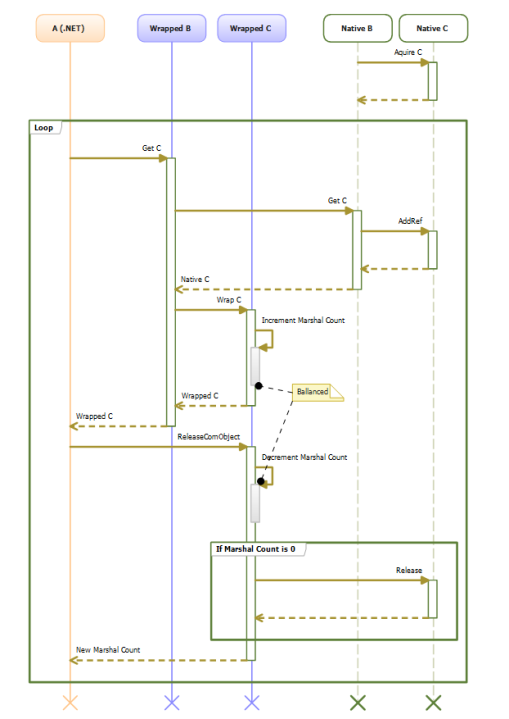
When you use a COM object in .NET the .NET framework creates a Runtime Callable Wrapper (RCW) which shows up in the debugger as __ComObject. This allows interoperation between managed .NET and native COM code. One of the major differences between C++ COM and .NET is that in C++ you have deterministic destruction while in .NET objects are finalized at the garbage collector’s leisure. Which mode of operation is preferable is a matter of taste and not the topic of this post (I’ll just say that you can take my deterministic destruction when my cold dead hand goes out of scope) however mixing the two modes can cause problems.

The SOP is that the RCW calls AddRef[1] on the COM object it is holding so that it won’t disappear while it’s being used and then, when the RCW is collected by the GC, it will release this reference in its finalizer. This works if you don’t care exactly when the COM object is released and .NET exposes Marshal.ReleaseComObject for cases in which you want to manually control the object’s lifetime.

We recently re-implemented a few interfaces (that were previously native COM) in .NET and stuff stopped working. A bit of debugging later I find that we’re calling ReleaseComObject on an object that is now implemented in .NET, this causes an ArgumentException to be thrown. A cow-orker pointed me at a post titled Marshal.ReleaseComObject Considered Dangerous (well at least it’s not harmful), this post describes the problem we were facing and the solution I already put in place (check with Marshal.IsComObject before calling ReleaseComObject) but goes on saying that this isn’t enough since once you call ReleaseComObject the RCW is disconnected from the COM object and can’t be used (and that this can be a problem if the RCW is cached). I thought that this is a theoretical problem (I know we aren’t caching the RCWs) and kept trying to figure out why our code still wasn’t working.

It turns out that as in everything in programming it’s all about adding another level.  We had three levels, a .NET class (which we’ll call A) a native class (C) and class B which was native in a previous incarnation but is now .NET, A holds a reference to B which hands it a C (via a method or property), but why is this a problem?

For that we’ll need to dive a bit deeper into how RCWs work.

Read more: I will not buy this blog, it is scratched!
QR: https://chart.googleapis.com/chart?chs=80x80&cht=qr&choe=UTF-8&chl=http://lanzkron.wordpress.com/2011/01/06/wrappers-unwrapped/

Posted via email from Jasper-Net

1 page, 101 Office 2010 Code Samples

Microsoft Office 2010 gives you the tools needed to create powerful applications. These Visual Basic for Applications (VBA) code samples can assist you in creating your own applications that perform specific functions or as a starting point to create more complex solutions.

Each code sample consists of approximately 5 to 50 lines of code demonstrating a distinct feature or feature set in VBA. Each sample includes comments describing the sample, and setup code so that you can run the code with expected results or the comments will explain how to set up the environment so that the sample code runs.)

Read more: Greg's Cool [Insert Clever Name] of the Day
Read more: Office 2010 Code Samples
QR: hh360994

Posted via email from Jasper-Net

Python Tools for Visual Studio

image1.png?psid=1

Today, I’m excited to announce the release of Python Tools for Visual Studio (PTVS), which is now available for download from CodePlex.

The Python ecosystem has been enjoying tremendous growth over the past few years, attracting all types of programmers from scientists to web developers to hobbyists. To support this growing community, we’ve released PTVS, an extension to Visual Studio that provides for Python the wealth of features developers desire in a modern and mature IDE. PTVS is aimed at enthusiast and professional Python developers alike. PTVS also includes features specialized for technical computing. Over the past several months, I’ve blogged about multiple projects related to our technical computing initiative, including Solver Foundation, Dryad, and TPL Dataflow.  PTVS is another unique and exciting project in this area. It's a free extension to Visual Studio that can be used with the Visual Studio Integrated Shell (available for free download) as well as with Visual Studio Professional and higher.

Read more: Somasegar's WebLog
QR: python-tools-for-visual-studio.aspx

Posted via email from Jasper-Net